If you work in electronics manufacturing, you know the daily balancing act. You are pushing out thousands of complex units, whether that is rugged automotive control modules or the latest consumer wearables, and every one of them has to seal. Getting product out of the door quickly matters, but not at the expense of quality.
When your products have to survive
harsh environments and meet IP ratings such as IP67 or IP68 under IEC 60529, a
microscopic flaw is not a small defect; it is a field failure waiting to
happen. So how do you keep the line moving at speed without compromising the
integrity of your seals?
The Bottleneck of Traditional Testing
We hear this constantly. Traditional
leak testing often sits like a roadblock at the end of the line. You might be
relying on air decay testing, which catches larger defects but struggles with
the microscopic leaks that let moisture and dust in over time.
Push the sensitivity of those older
methods and the test cycle stretches. Your test station becomes the constraint,
and the rest of the line waits for it. That is a poor trade: the process meant
to protect quality is the one holding output back.
Finding Micro-Leaks Without the Cycle Time Penalty
At Nolek, we do not believe you should have to choose between a fast line and a reliable product. We have spent years designing custom engineered systems for high-speed, high-mix production, where the test station has to keep pace with everything upstream of it.
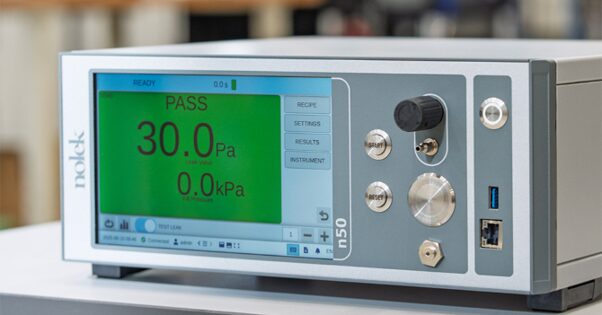
The answer is precision helium leak testing. Helium is inert, and its small atomic size lets it pass through the pathways other methods miss. For very small leak rates, pressure decay testing can require longer test times to achieve the necessary sensitivity. Helium leak testing can detect these micro-leaks within the required production cycle time, keeping the test station from becoming a bottleneck Integrated directly into your workflow, it resolves leak rates air decay cannot reach within wanted cycletime, without adding cycle time. That gives you greater confidence that <evidence< del=””> your products are sealed against moisture and dust ingress, rather than an assumption.</evidence<>
Built for Changeovers, Not Just
for Testing
A sensitive instrument is only part of
the answer. If it does not fit your existing operations, it creates more
problems than it solves. Electronics manufacturing moves quickly, and the
equipment has to move with it.
That is why we build automation-ready
systems around the way high-mix lines actually run. Fixtures are engineered for
rapid reconfiguration between variants, with tooling shared across part
families and test parameters stored per product. When it is time to switch from
one device to the next, the changeover is something your operators can complete
themselves, minimising downtime between batches.
Furthermore, we make sure our systems
talk seamlessly with your existing infrastructure, integrating directly with
your MES and ERP software. Every test is logged automatically, giving you
unit-level traceability. If you ever face an audit or need to review historical
data, everything is completely transparent and compliant.
Partnership for Success
Meeting IP ratings while holding production targets is demanding, but you do not have to work it out alone. We view our relationship with our customers as a true partnership. From the early stages of system design to post-installation support, our team is alongside you, offering guidance and technical expertise.
Upgrading your leak testing is also a chance to simplify the end of your line, not just to satisfy a standard.
If changeover time is what holds your test station back, tell us how many variants run on the line and what cycle time you need to hit, and we will show you what a shared-fixture setup would look like.