
Manufacturing high-pressure heat pumps comes with a unique set of challenges. You are working with modern refrigerants and operating under intense pressures, which means ensuring a perfectly sealed system is an absolute necessity for performance and safety. Finding the right testing method to guarantee that quality is something every production manager wrestles with. Here at Nolek, we have spent years helping manufacturers perfect their leak testing lines, and recently, we began exploring a fresh approach, what if we could help you match your tracer gas perfectly to the actual leak rate your product demands?
The Missing Middle Ground in Leak Detection
For decades, industries have relied on helium for leak testing, making it the standard in the manufacturing world. It is an incredible tracer gas and the undisputed champion for detecting ultra-fine leaks. Thanks to its tiny atomic size and inert nature, it can effortlessly find microscopic defects down to 10⁻¹² mbar·L/s. Helium will always be a brilliant and essential tool for high-sensitivity industrial testing and ultra-high vacuum environments.
However, because standard pressure decay testing often falls short of the sensitivity required for modern heat pumps, manufacturers naturally default to helium for everything. The question we started asking is whether you always need that maximum level of premium sensitivity for every single application on the factory floor.
This is exactly where argon comes into the picture as the next-generation tracer gas. We are not looking to replace helium; in fact, utilising argon for moderate leaks allows you to preserve your valuable helium supply for the highly specialised tasks where it truly shines. Instead, argon serves as a highly effective, complementary middle ground. It perfectly bridges the gap in industrial leak detection between the basic capabilities of pressure decay and the extreme, microscopic sensitivity of helium.
What Our Real-World Testing Revealed
We wanted to see exactly how this complementary strategy played out in real-world scenarios. Since 2020, our engineers have conducted over 300 test runs to evaluate alternative gases in various pressure ranges. When we looked specifically at heat pump components, which often have a practical leak requirement around 1×10⁻³ mbar·L/s, the results were incredibly eye-opening.
- Finding the Ideal Sweet Spot: Argon proved to be a fantastic candidate for leakage test systems where reject rates sit in the 10⁻⁵ mbar·L/s range. It is the optimal choice for industrial applications where helium’s extreme properties simply aren’t required.
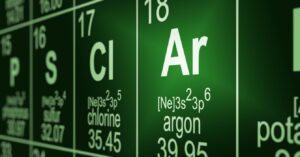
- Managing the Background Signal: Because argon makes up roughly 0.93% of the Earth’s atmosphere, the ambient background signal is naturally higher than helium. Modern testing equipment handles this beautifully by using dynamic background compensation algorithms. These systems mathematically extrapolate the falling background curve, allowing you to accurately pinpoint leaks early in the cycle without waiting for long equilibrium times.
- Rock-Solid Process Stability: Running parallel testing in active production environments confirmed that argon maintains excellent process stability, better predictability, and long-term reliability. Industry leaders like NIBE are already successfully running their heat pump production lines with argon.
The Strategic Benefits of Right-Sizing
Beyond the mechanics of the testing chamber itself, adding argon to your toolkit makes brilliant operational sense. When you step back and look at the bigger picture, you can optimise your entire testing strategy by using the right gas for the right job.
- Secure Supply Chains: Argon is effectively unlimited and produced as a widely available by-product of air separation. This makes it significantly less sensitive to the geopolitical disruptions that frequently impact helium supplies.
- Cost Efficiency: Utilising argon allows production facilities to save millions annually. In many industrial markets, helium can cost 5 to 15 times more per cubic meter than argon. By strategically integrating argon into your manufacturing process, you can streamline costs and simplify operations for your everyday testing needs.
- Sustainable Practices: Helium is a finite, non-renewable natural resource. By transitioning your moderate leak testing to argon, which is abundant in the atmosphere, you are building a much more sustainable and eco-friendly process.
Every challenge on the production line is a chance to create something smarter, more sustainable, and more efficient. With the right approach, achieving your leak testing objectives is closer than you think. If you are ready to explore how this balanced, dual-gas strategy can optimise your heat pump production, the team at Nolek is here to act as your trusted partner. As the first supplier worldwide to offer Argon-based solutions, let our engineers help you evaluate your current setup today, without ever compromising your results.