For the Test Engineer, it’s a Tuesday morning: the helium background noise is climbing, your legacy pressure-decay fixtures are throwing false fails, and the line is backing up. For the Operations Director, it’s a Friday afternoon: the quarterly scrap report shows a 2% margin erosion, and a looming safety audit for the new R290 (Propane) production line is keeping you in the office late.
In 2026, these aren’t separate problems. They are the same problem viewed from different heights. As the HVAC sector completes its transition to A2L and natural refrigerants, the “good enough” testing of the past has become the primary bottleneck to both safety and profit.
The Test Engineer’s Front Line: Ending the “Guesswork”
On the shop floor, the theory of “quality” meets the relentless demand of “throughput.” With the phase-out of high-GWP refrigerants like R-410A, you are now working with mildly flammable A2L gases or high-pressure CO2.
- The Tactical Pain: You are likely battling temperature fluctuations that render pressure-decay readings useless. You are chasing “ghost leaks” caused by poor fixture seals, leading to a “bumpy road” of inconsistent data.
- The Nolek Fix: Shifting to Hard Vacuum Helium testing. Using helium leak detectors, you move beyond a simple “Pass/Fail” light. You achieve a quantifiable leak rate of 10x-7 mbar·l/s, enabling you to meet strict safety standards with ease.
- The Relatable Result: No more water baths. No more “maybe it’s a leak, maybe it’s the weather.” Just objective, repeatable data that lets you clear the line with total confidence.
The Operations Director’s Stakes: Protecting the Margin
When overseeing a €16 million+ facility, “precision” is just another word for “predictability.” The electrification surge means your volumes must double, but your floor space and labour pool remain fixed.
- The Business Pain: High scrap rates in the brazing section are burning cash. Manual testing is a bottleneck that prevents you from hitting your beat-rate targets. Every field failure of a new heat pump unit costs upwards of €1,000 in service calls and reputational damage.
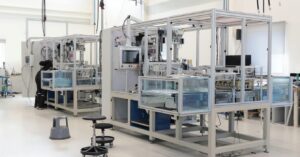
- The Nolek Fix: Custom Automation. By integrating Nolek’s automated leak test cells directly into the assembly line, you replace three manual stations with one high-speed unit.
- The Relatable Result: You reduce rework and scrap costs by 30–50%. You gain full traceability—meaning when a Tier-1 customer or regulator asks for proof of integrity for Serial Number #40592, you pull a digital certificate in seconds, not days.
The Bridge: Helium Recovery
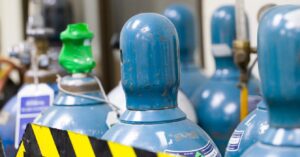
The Engineer hates the hassle of changing gas cylinders and the downtime of supply shortages. The Director hates the volatile, rising invoices from the gas supplier.
- Tactical Action: Integrate a Helium recovery system.
- The Result: The Engineer rarely has to swap tanks because 90+% of the gas is recycled and purified for the next cycle. The Director sees a 24-month ROI on the equipment because the recurring OPEX for helium drops off a cliff. It transforms an unpredictable commodity cost into a stable, long-term asset.
The HVAC Leak Test Readiness Checklist
If you are a Test Engineer… | If you are an Operations Director… |
Are your fixtures repeatable, or are you “fudging” the seals to pass? | Is your rework and scrap rate higher than 1.5%? |
Can you detect leaks in under 30 seconds to keep pace with the line? | Are you prepared for the safety and liability audits of A2L/R290 lines? |
Is your equipment “end-of-life” and lacking spare parts for 2026 demands? | Does your current throughput match your 2026-2028 sales forecast? |
The Bottom Line
Nolek has spent over 50 years in the HVAC sector. We understand that the Engineer wants a machine that actually works on the production floor, and the Director wants a machine that actually pays for itself.
Whether it is a standard instrument for sub-assembly screening or a bespoke automated vacuum chamber for a final heat pump unit, Nolek provides the “Total Solution” that bridges the gap between technical excellence and commercial success.