Choosing the wrong testing method is like using a ruler to measure a hair’s breadth, frustratingly inaccurate and ultimately unfit for purpose. As manufacturing tolerances tighten, the gap between “detecting a leak” and “measuring a leak” has never been more critical.
The Great Leak Testing Dilemma
For test engineers in the HVAC and automotive sectors, the choice often boils down to two established methods: Pressure Decay and Hard Vacuum Helium Testing.
While both methods aim to ensure product integrity, they operate on different physical principles and offer vastly different levels of sensitivity. Choosing based on the machine’s price tag alone—rather than the specific physics of your component—is a recipe for high scrap rates or, worse, field failures.
Side-by-Side: The Technical Reality
Feature | Pressure Decay | Hard Vacuum (Helium) |
Sensitivity | 10-3 mbar l/s (Gross leaks) | 10-6 mbar to 10-9 mbar ·l/s (Ultra-fine leaks) |
Speed | Slow for large volumes (needs stabilization) | Fast (independent of volume size) |
Environmental Influence | High (highly sensitive to temperature) | Low (vacuum environment is stable) |
Cost | Lower Initial CAPEX | Higher CAPEX / Lower long-term OPEX |
Location Ability | No (Pass/Fail only) | Yes (can pinpoint leak source) |
Which Method for Which Component?
In a modern heat pump or EV production line, one size rarely fits all. With our 50+ years of experience, we are seeing more of a tiered application:
- Pressure Decay: Best suited for simple, low-pressure components or as a preliminary “gross leak” check. It is effective for ensuring an assembly isn’t missing a gasket, but it lacks the resolution to find the micro-fissures that lead to slow refrigerant loss.
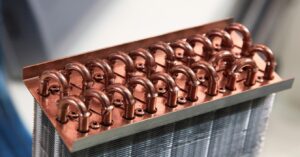
- Hard Vacuum (Helium): Essential for critical “hermetic” components such as evaporator coils, compressors, and battery housings. Using our high-sensitivity instruments, this method detects leaks so small they would take 30 years to deflate a balloon, the exact level of precision required for A2L and R290 refrigerant safety.
The “Hybrid” Sweet Spot
We are advocates of the Hybrid Workflow. Instead of choosing one method, leading OEMs are integrating both into a single automated station:
- Gross Test (Pressure): Quickly identifies major assembly errors without wasting tracer gas.
- Fine Test (Hard Vacuum): Immediately follows with a helium mass spectrometer test to certify the unit to 10-5 mbar l/s.
This approach minimizes cycle times and ensures that the expensive vacuum chamber is never contaminated by a major leaker.
Common Myths Busted
- “Helium is too expensive”: With a Nolek recovery system, the majority of your tracer gas can be reused, making the per-test cost comparable to air.
- “Vacuum testing is too slow”: Actually, because vacuum testing isn’t delayed by temperature stabilization (unlike pressure decay), it is often the faster choice for large-volume components like heat exchangers.
The Nolek Recommendation
The “right” method is the one that aligns with your quality specification and regulatory requirements. If you are converting to natural refrigerants or high-density electronics, the industry is moving decisively toward hard vacuum.