In the high-volume heat pump market, scrap isn’t just a waste of materials; it is lost production capacity that your competitors are ready to seize. As the electrification of heating accelerates, the difference between a profitable line and a struggling one often comes down to the speed and accuracy of the final leak test.
The Scaling Challenge
The global shift towards heat pumps represents a structural change in manufacturing. Many OEMs are transitioning from batch-style assembly to high-speed, continuous production lines. In this environment, manual leak testing, such as water bath “bubble” testing or basic pressure decay, becomes a critical bottleneck.
Manual testing is inherently subjective and slow. It introduces the risk of human error, where a fatigued operator might miss a micro-leak or misinterpret a gauge reading. For a heat pump manufacturer aiming to double or triple volume, these “minor” inefficiencies scale into major financial losses.
The Automation Advantage: Objective Precision
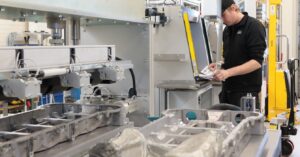
Upgrading to an automated hard vacuum helium leak testing system, a core Nolek custom solution, removes the human variable from the equation.
- Cycle-Time Gains: Automated systems can perform complex testing sequences (gross and fine leaks) in a fraction of the time required for manual methods.
- Throughput Reliability: While a manual station might handle 5 units per hour, a Nolek automated cell can be engineered to meet the exact beat-rate of your production line, ensuring no unit leaves the factory without a certified, data-logged “Pass.”
- Traceability: Every test result is digitally captured. In a sector where regulatory demands are tightening, having a serial-linked record of every unit’s integrity is a vital shield against future liability.
Calculating the ROI
When Nolek implements an automated system, we focus on three primary pillars of ROI:
- Direct Labour Savings: An automated Nolek machine typically requires 50–70% less operator intervention than a manual setup. In many cases, a single operator can oversee multiple testing stations.
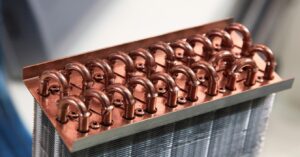
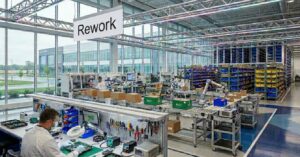
- Scrap & Rework Reduction: Industry benchmarks suggest that inefficient testing can lead to 0.6% to 2.2% of revenue being lost to scrap and field claims. By catching leaks earlier in the sub-assembly phase (e.g., testing coils before final assembly), Nolek customers frequently reduce rework costs by 30–50%.
- Warranty & Brand Protection: The most significant “invisible” ROI is the avoidance of field failures. A single refrigerant leak in a residential heat pump can cost upwards of €1,000 to repair on-site, not including the damage to the manufacturer’s reputation.
The 12-Month Payback Model
For high-volume HVAC manufacturers, the capital investment in a Nolek automated system often reaches a break-even point within 12 to 18 months. This is achieved through the combination of higher yield, lower gas consumption (leveraging helium recovery), and significantly reduced after-sales service requirements.
As Nolek’s 50-year history in the HVAC sector proves, automation is not just about replacing a person with a machine; it’s about securing a quality standard that manual processes simply cannot reach.
Ready to Scale Your Production?